Pineapples are consistently overpriced at brand-name supermarket chains. In the DC area, you are extremely lucky if you can find them at $2 at a mainstream market (that's their price at Shoppers this week); usually they are in the $4 range. But go to an ethnic supermarket (e.g. H Market) and you'll find that they are at that price year round.
Wednesday, October 10, 2012

Tuesday, October 9, 2012
yes, but video piracy?
From today's Washington Post, on the death of ultra-violent drug lord Heriberto "The Executioner" Lazcano:
"An especially cruel, paramilitary cartel, the Zetas operate a diversified portfolio that includes not just drug trafficking but also extortion, kidnapping, video piracy and the theft of billions of dollars in oil and gas from Mexico’s state petroleum company." (emphasis added)
So this "especially cruel" organization's heinous crimes include include not just murder, drugs, kidnapping, extortion, billion dollar theft, but also video piracy. Horrors.
(I think the Entertainment Industry needs to come up with different names for different "tiers" of pirates. I assume, given that it made this list, that these people were "pirating videos" on a pretty large scale and that it genuinely ate into industry sales. But still, given that the vast majority of college students have engaged in what the industry calls "piracy" at one time or another, it just seems wrong to keep using that name for all actors, large and small.)
"An especially cruel, paramilitary cartel, the Zetas operate a diversified portfolio that includes not just drug trafficking but also extortion, kidnapping, video piracy and the theft of billions of dollars in oil and gas from Mexico’s state petroleum company." (emphasis added)
So this "especially cruel" organization's heinous crimes include include not just murder, drugs, kidnapping, extortion, billion dollar theft, but also video piracy. Horrors.
(I think the Entertainment Industry needs to come up with different names for different "tiers" of pirates. I assume, given that it made this list, that these people were "pirating videos" on a pretty large scale and that it genuinely ate into industry sales. But still, given that the vast majority of college students have engaged in what the industry calls "piracy" at one time or another, it just seems wrong to keep using that name for all actors, large and small.)
Monday, October 8, 2012
Who won? Who knows?
Ok, I'm going to have to say it. Yes, in hindsight, and with the help of EVERYONE in the media saying Romney won the debate -- and with even Obama admitting that he made a poor showing -- I can see why people are saying Romney won the debate. But are we really sure that's what those polled were thinking when they watched the debate, or is that just the position they ended up imputing to themselves after the relentless Romney-won-the-debate drumbeat from the media? The latest Pew poll says that:
2/3 of all registered voters think Romney won
20 percent think Obama won
72 percent of independents think Romney won
78 percent of independents who watched the debate think Romney won.
I happened to be watching on the HuffingtonPost channel. The post-debate commentators were not exactly world-class pundits -- and they were extremely young, and couldn't help themselves from talking about drinking games that one could play during the debate -- but clearly had some journalism experience. Yet none of them seemed to sense, in the immediate aftermath, that Romney had won as "big" as everyone now thinks he did. In fact, I don't think any of them called the debate for either side -- their unanimous view seemed to be that the whole thing was a "snoozefest." I remember the woman saying something like "I'm a wonk, and even I was bored by all the numbers they were throwing around." In other words, while these may have been average journalists, they were certainly better informed than the "average" voter. So did "average" voters really think Romney "won" the debate at the time? Who knows?
I was watching too, and I wasn't really sure. Yes, Romney was ruder to the moderator, and therefore got to say more of what he wanted to say, even when he wasn't really supposed to. But you'd LOSE a high school debate by default if you did that. And from what I could gather, his plan is to pay for the tax cut to the rich by stopping funding for public television. It turns out that public broadcasting only gets $430 million. If Romney's tax cuts really will amount to $5 trillion, that $430 million is less than 0.001 percent of what he needs to help out his rich buddies (and himself). It's also a trivial amount compared to the hundreds of billions Romney wants to pump into the defense budget.
Yes I was a bit embarrassed by Barack's performance. Romney came out with a whole new game plan, and Obama did not think well on his feet. He kept repeating the $5 trillion, without explaining how radically the "new" Romney was departing from the "old" one. Romney was telling a completely different story, but rather than attack him on that, Obama kept attacking the old story.
2/3 of all registered voters think Romney won
20 percent think Obama won
72 percent of independents think Romney won
78 percent of independents who watched the debate think Romney won.
I happened to be watching on the HuffingtonPost channel. The post-debate commentators were not exactly world-class pundits -- and they were extremely young, and couldn't help themselves from talking about drinking games that one could play during the debate -- but clearly had some journalism experience. Yet none of them seemed to sense, in the immediate aftermath, that Romney had won as "big" as everyone now thinks he did. In fact, I don't think any of them called the debate for either side -- their unanimous view seemed to be that the whole thing was a "snoozefest." I remember the woman saying something like "I'm a wonk, and even I was bored by all the numbers they were throwing around." In other words, while these may have been average journalists, they were certainly better informed than the "average" voter. So did "average" voters really think Romney "won" the debate at the time? Who knows?
I was watching too, and I wasn't really sure. Yes, Romney was ruder to the moderator, and therefore got to say more of what he wanted to say, even when he wasn't really supposed to. But you'd LOSE a high school debate by default if you did that. And from what I could gather, his plan is to pay for the tax cut to the rich by stopping funding for public television. It turns out that public broadcasting only gets $430 million. If Romney's tax cuts really will amount to $5 trillion, that $430 million is less than 0.001 percent of what he needs to help out his rich buddies (and himself). It's also a trivial amount compared to the hundreds of billions Romney wants to pump into the defense budget.
Yes I was a bit embarrassed by Barack's performance. Romney came out with a whole new game plan, and Obama did not think well on his feet. He kept repeating the $5 trillion, without explaining how radically the "new" Romney was departing from the "old" one. Romney was telling a completely different story, but rather than attack him on that, Obama kept attacking the old story.
Friday, October 5, 2012
Small Business and the Presidential Debate -- Who are the 3%?
The following exchange from the debate interested me, for reasons I'll give below:
OBAMA: And we do have a difference, though, when it comes to definitions of small business. Under -- under my plan, 97 percent of small businesses would not see their income taxes go up. Governor Romney says, well, those top 3 percent, they're the job creators, they'd be burdened.
But under Governor Romney's definition, there are a whole bunch of millionaires and billionaires who are small businesses. Donald Trump is a small business. Now, I know Donald Trump doesn't like to think of himself as small anything, but -- but that's how you define small businesses if you're getting business income.
And that kind of approach, I believe, will not grow our economy, because the only way to pay for it without either burdening the middle class or blowing up our deficit is to make drastic cuts in things like education, making sure that we are continuing to invest in basic science and research, all the things that are helping America grow. And I think that would be a mistake.
LEHRER: All right.
ROMNEY: Jim, let me just come back on that -- on that point, which is these ...
LEHRER: Just for the -- just for record ...
(CROSSTALK)
ROMNEY: ... the small businesses we're talking about ...
LEHRER: Excuse me. Excuse me. Just so everybody understands, we're way over our first 15 minutes.
ROMNEY: It's fun, isn't it?
LEHRER: It's OK, it's great. No problem. Well, you all don't have -- you don't have a problem, I don't have a problem, because we're still on the economy. We're going to come back to taxes. I want move on to the deficit and a lot of other things, too.
OK, but go ahead, sir.
ROMNEY: You bet. Well, President, you're -- Mr. President, you're absolutely right, which is that, with regards to 97 percent of the businesses are not -- not taxed at the 35 percent tax rate, they're taxed at a lower rate. But those businesses that are in the last 3 percent of businesses happen to employ half -- half of all the people who work in small business. Those are the businesses that employ one-quarter of all the workers in America. And your plan is to take their tax rate from 35 percent to 40 percent.
Now, and -- and I've talked to a guy who has a very small business. He's in the electronics business in -- in St. Louis. He has four employees. He said he and his son calculated how much they pay in taxes, federal income tax, federal payroll tax, state income tax, state sales tax, state property tax, gasoline tax. It added up to well over 50 percent of what they earned. And your plan is to take the tax rate on successful small businesses from 35 percent to 40 percent. The National Federation of Independent Businesses has said that will cost 700,000 jobs.
I don't want to cost jobs. My priority is jobs. And so what I do is I bring down the tax rates, lower deductions and exemptions, the same idea behind Bowles-Simpson, by the way, get the rates down, lower deductions and exemptions, to create more jobs, because there's nothing better for getting us to a balanced budget than having more people working, earning more money, paying more taxes. That's by far the most effective and efficient way to get this budget balanced.
---
I'm just trying to figure out who exactly these three percent are. Are they all Donald Trump, or are they the guy in St. Louis? What do the statistics say?
First, let's try to get a handle on what the candidates are saying above.
Small business income is considered regular income. So if you raise the income tax on some segment of the population, you are going to be raising taxes on small businesspeople in that segment. Obama says he won't raise taxes on 97% of small businesses. From elsewhere, we know that he's not going to raise taxes on people who make less than $250K. Based on these two figures, it follows that he won't raise taxes on small businesses having incomes of $250K or less. It also follows that he will raise taxes on small business owners whose incomes exceed $250K. From the figures that BOTH candidates seemed to agree on, this means that 3% of small businesses are owned by people making more than $250K and that under Obama's plan these people would be taxed more. Romney, on the other hand, would not tax them more, because he says that these rich small business owners employ half the workers in the United States.
Here is some info on SBA size requirements (for purposes of determining if a business is a "small" business) from SBA site:
-- Manufacturing: Maximum number of employees may range from 500 to 1500, depending on the type of product manufactured;
-- Wholesaling: Maximum number of employees may range from 100 to 500 depending on the particular product being provided;
-- Services: Annual receipts may not exceed $2.5 to $21.5 million, depending on the particular service being provided;
-- Retailing: Annual receipts may not exceed $5.0 to $21.0 million, depending on the particular product being provided;
-- General and Heavy Construction: General construction annual receipts may not exceed $13.5 to $17 million, depending on the type of construction;
-- Special Trade Construction: Annual receipts may not exceed $7 million; and
-- Agriculture: Annual receipts may not exceed $0.5 to $9.0 million, depending on the agricultural product.
So far so good. We really need to get more data, but this already tells us that a small business CAN be pretty big -- you can employ up to 1500 people if you're in manufacturing; and you can have "receipts" of over $20 million if you're in some types of services and retailing.
We don't yet have data on exactly who the 3% are. One can readily imagine that there are a good number of "big" small businesses out there. In fact, Romney tells us that the 3% are responsible for half of the nation's jobs. Based on this, it seems highly unlikely that the guy with the 4 employees in St. Louis is even in the 3%.
Low hanging fruit: Without knowing any breakdowns whatsoever, we can see a fallacy in Romney's argument. Romney's basic idea is that he will NOT raise taxes on anyone with an income greater than $250K. And his justification is that some people with incomes over $250K are small business owners and job creators. But until someone tells us how many of them are small business owners, we must reject his argument. As we saw above in "Who Are the 1%?", people earning over 250K are typically doctors, lawyers, real estate developers, consultants, bankers, etc. While some of these people certainly provide jobs, they are not all necessarily "growing" businesses. So if we're trying to help rich small business owners, there's no reason that we need to help the rest of the rich as well.
And that leads to the second question -- Do we need to help rich small business owners by giving them tax breaks? By definition, these are people whose small businesses are generating more than $250K in income for them.
The reason they are making this income is simple economics -- this is the money they take in from their customers, minus the money they pay for material and labor.
Read what I just wrote again. And then try to think of circumstances under which taxing this profit would cause a business to stop hiring employees.
A business will hire a new employee when the business realizes that it can get more money from customers than it has to pay in expenses, including the employee's salary. In other words, the decision to hire another employee will typically have nothing whatsoever to do with your tax rate. If I have a great product, but am having trouble getting the word out, I might decide to hire a new sales person, on the theory that the sales person will cause more sales to occur, and as a result my profits due to that sales person will exceed what I had to pay that salesperson.
Obviously, there is always a risk involved in hiring a new employee. If the employee ends up costing me more money than I can make off of his work, I lose money. So presumably an employer does some kind of calculation before hiring. He makes his best guess as to the probabilities of different outcomes, and chooses the outcome that will give him an expected income greater than zero (or significantly greater than zero, if he is risk averse). Some employees will turn out to be real profit centers; others, not so much. And if there's an economic downturn or other unforeseen event, each employee on the payroll will be a problem.
Taxes DO play a part in this calculation, but really only a very minor part. For example, say I hire an employee for $100K, on the thought that I'll get $110K back, i.e. I'll make $10K off of the employee. At the 35% tax rate, I'd get to keep $6500 of the $10K; whereas at 40%, I'd get to keep $6K. I might not do the hire if I thought the employee would likely mean considerably less than the $10K, but there are very few cases where the difference between the possible outcomes due to taxes (in the example given, merely 0.5% of the investment in the employee) will make the difference between hiring and not hiring. In fact, the GREATER this percentage, the MORE likely I am to do the hire, since that will suggest that I am making more money per employee.
I also found this article by Sarah Ayres of the Center for American Progress.
The article confirms what I'm saying above -- "Small-business owners overwhelmingly are not millionaires, and the vast majority of millionaires do not make their millions from small business."
-- it notes that a report by the Office of Tax Analysis at the U.S. Treasury defines a “small business” as "a flow-through entity that engages in business activity and has income over $10,000 but less than $10 million. A small business is then considered an employer if it has at least $10,000 in labor deductions."
OBAMA: And we do have a difference, though, when it comes to definitions of small business. Under -- under my plan, 97 percent of small businesses would not see their income taxes go up. Governor Romney says, well, those top 3 percent, they're the job creators, they'd be burdened.
But under Governor Romney's definition, there are a whole bunch of millionaires and billionaires who are small businesses. Donald Trump is a small business. Now, I know Donald Trump doesn't like to think of himself as small anything, but -- but that's how you define small businesses if you're getting business income.
And that kind of approach, I believe, will not grow our economy, because the only way to pay for it without either burdening the middle class or blowing up our deficit is to make drastic cuts in things like education, making sure that we are continuing to invest in basic science and research, all the things that are helping America grow. And I think that would be a mistake.
LEHRER: All right.
ROMNEY: Jim, let me just come back on that -- on that point, which is these ...
LEHRER: Just for the -- just for record ...
(CROSSTALK)
ROMNEY: ... the small businesses we're talking about ...
LEHRER: Excuse me. Excuse me. Just so everybody understands, we're way over our first 15 minutes.
ROMNEY: It's fun, isn't it?
LEHRER: It's OK, it's great. No problem. Well, you all don't have -- you don't have a problem, I don't have a problem, because we're still on the economy. We're going to come back to taxes. I want move on to the deficit and a lot of other things, too.
OK, but go ahead, sir.
ROMNEY: You bet. Well, President, you're -- Mr. President, you're absolutely right, which is that, with regards to 97 percent of the businesses are not -- not taxed at the 35 percent tax rate, they're taxed at a lower rate. But those businesses that are in the last 3 percent of businesses happen to employ half -- half of all the people who work in small business. Those are the businesses that employ one-quarter of all the workers in America. And your plan is to take their tax rate from 35 percent to 40 percent.
Now, and -- and I've talked to a guy who has a very small business. He's in the electronics business in -- in St. Louis. He has four employees. He said he and his son calculated how much they pay in taxes, federal income tax, federal payroll tax, state income tax, state sales tax, state property tax, gasoline tax. It added up to well over 50 percent of what they earned. And your plan is to take the tax rate on successful small businesses from 35 percent to 40 percent. The National Federation of Independent Businesses has said that will cost 700,000 jobs.
I don't want to cost jobs. My priority is jobs. And so what I do is I bring down the tax rates, lower deductions and exemptions, the same idea behind Bowles-Simpson, by the way, get the rates down, lower deductions and exemptions, to create more jobs, because there's nothing better for getting us to a balanced budget than having more people working, earning more money, paying more taxes. That's by far the most effective and efficient way to get this budget balanced.
---
I'm just trying to figure out who exactly these three percent are. Are they all Donald Trump, or are they the guy in St. Louis? What do the statistics say?
First, let's try to get a handle on what the candidates are saying above.
Small business income is considered regular income. So if you raise the income tax on some segment of the population, you are going to be raising taxes on small businesspeople in that segment. Obama says he won't raise taxes on 97% of small businesses. From elsewhere, we know that he's not going to raise taxes on people who make less than $250K. Based on these two figures, it follows that he won't raise taxes on small businesses having incomes of $250K or less. It also follows that he will raise taxes on small business owners whose incomes exceed $250K. From the figures that BOTH candidates seemed to agree on, this means that 3% of small businesses are owned by people making more than $250K and that under Obama's plan these people would be taxed more. Romney, on the other hand, would not tax them more, because he says that these rich small business owners employ half the workers in the United States.
Here is some info on SBA size requirements (for purposes of determining if a business is a "small" business) from SBA site:
-- Manufacturing: Maximum number of employees may range from 500 to 1500, depending on the type of product manufactured;
-- Wholesaling: Maximum number of employees may range from 100 to 500 depending on the particular product being provided;
-- Services: Annual receipts may not exceed $2.5 to $21.5 million, depending on the particular service being provided;
-- Retailing: Annual receipts may not exceed $5.0 to $21.0 million, depending on the particular product being provided;
-- General and Heavy Construction: General construction annual receipts may not exceed $13.5 to $17 million, depending on the type of construction;
-- Special Trade Construction: Annual receipts may not exceed $7 million; and
-- Agriculture: Annual receipts may not exceed $0.5 to $9.0 million, depending on the agricultural product.
So far so good. We really need to get more data, but this already tells us that a small business CAN be pretty big -- you can employ up to 1500 people if you're in manufacturing; and you can have "receipts" of over $20 million if you're in some types of services and retailing.
We don't yet have data on exactly who the 3% are. One can readily imagine that there are a good number of "big" small businesses out there. In fact, Romney tells us that the 3% are responsible for half of the nation's jobs. Based on this, it seems highly unlikely that the guy with the 4 employees in St. Louis is even in the 3%.
Low hanging fruit: Without knowing any breakdowns whatsoever, we can see a fallacy in Romney's argument. Romney's basic idea is that he will NOT raise taxes on anyone with an income greater than $250K. And his justification is that some people with incomes over $250K are small business owners and job creators. But until someone tells us how many of them are small business owners, we must reject his argument. As we saw above in "Who Are the 1%?", people earning over 250K are typically doctors, lawyers, real estate developers, consultants, bankers, etc. While some of these people certainly provide jobs, they are not all necessarily "growing" businesses. So if we're trying to help rich small business owners, there's no reason that we need to help the rest of the rich as well.
And that leads to the second question -- Do we need to help rich small business owners by giving them tax breaks? By definition, these are people whose small businesses are generating more than $250K in income for them.
The reason they are making this income is simple economics -- this is the money they take in from their customers, minus the money they pay for material and labor.
Read what I just wrote again. And then try to think of circumstances under which taxing this profit would cause a business to stop hiring employees.
A business will hire a new employee when the business realizes that it can get more money from customers than it has to pay in expenses, including the employee's salary. In other words, the decision to hire another employee will typically have nothing whatsoever to do with your tax rate. If I have a great product, but am having trouble getting the word out, I might decide to hire a new sales person, on the theory that the sales person will cause more sales to occur, and as a result my profits due to that sales person will exceed what I had to pay that salesperson.
Obviously, there is always a risk involved in hiring a new employee. If the employee ends up costing me more money than I can make off of his work, I lose money. So presumably an employer does some kind of calculation before hiring. He makes his best guess as to the probabilities of different outcomes, and chooses the outcome that will give him an expected income greater than zero (or significantly greater than zero, if he is risk averse). Some employees will turn out to be real profit centers; others, not so much. And if there's an economic downturn or other unforeseen event, each employee on the payroll will be a problem.
Taxes DO play a part in this calculation, but really only a very minor part. For example, say I hire an employee for $100K, on the thought that I'll get $110K back, i.e. I'll make $10K off of the employee. At the 35% tax rate, I'd get to keep $6500 of the $10K; whereas at 40%, I'd get to keep $6K. I might not do the hire if I thought the employee would likely mean considerably less than the $10K, but there are very few cases where the difference between the possible outcomes due to taxes (in the example given, merely 0.5% of the investment in the employee) will make the difference between hiring and not hiring. In fact, the GREATER this percentage, the MORE likely I am to do the hire, since that will suggest that I am making more money per employee.
I also found this article by Sarah Ayres of the Center for American Progress.
The article confirms what I'm saying above -- "Small-business owners overwhelmingly are not millionaires, and the vast majority of millionaires do not make their millions from small business."
-- it notes that a report by the Office of Tax Analysis at the U.S. Treasury defines a “small business” as "a flow-through entity that engages in business activity and has income over $10,000 but less than $10 million. A small business is then considered an employer if it has at least $10,000 in labor deductions."

-- there were 3.8 million small-business employers in the United States in 2007.
--3.3 percent of small businesses are owned by millionaires (a bit different from the statistic that both parties seemed to agree to in the debate -- that 3% of small business owners earned 250K or more.
I'm quoting the next one in full, because the text doesn't seem to match the chart (Figure 2) in two ways. The text quite clearly states that only about 20% of small business income goes to millionaires, but the title says "less than 20% of small business owners are millionaires" (whereas above, we've been told it's 3%), and the pie chart is labeled "millionaires' income by source" which bears nto relation to the text or the rest of the pie chart. But if you look past the label on the chart, the numbers do match up -- apparently millionaires only do take home about 20% of small business income.
- "Millionaires take home only 19 percent of small-business employer income. Small-business owners made $183 billion in 2007. Most of this income was earned by employers who made less than $1 million that year. In fact, the majority was earned by employers who make less than half that; 60 percent of small-business employer income went to individuals who earned less than $500,000 [PF Note: possibly wrong, since chart gives 57.8% for people making 200K-1M]. About a quarter was earned by employers making less than $200,000 a year. Most of the income earned through small businesses does not go to millionaires. It goes to businessmen and businesswomen who make much less. (See Figure 2)"


-- And Figure 3 is fairly self-explanatory -- millionaires are overwhelmingly NOT getting their income from running small businesses.
So based on all of this, I'm baffled why Obama didn't give a more coherent response to Romney's point about the 3% (i.e. that 3% of small business owners are rich small business owners who provide more than half of the jobs in this country).
The answer would have been:
1) That's no reason for lowering (or keeping low) taxes on ALL rich people, since the statistics show that only a tiny percentage of rich peoples' income has anything to do with small business.
2) And remember, the 3% of small business owners that we're talking about are those who are making more than $250K from their business [if that's right; the graph above seems to suggest that about 25% make over $200K, and that the 3% is millionaires]. Why shouldn't they pay the same tax rate as other people making that kind of money/
3) There's no showing anywhere that increasing taxes from 35% to 40% is going to significantly affect hiring decisions. If you're thinking about hiring a new worker, you will only do that if you are pretty sure you'll make enough money off of that worker to offset the risks involved of the hiring. That last 5% is a trivial amount, as PriceFixer has shown in his/her blog. It is highly unlikely to affect hiring decisions -- if you thnk you'll make good money off of another hire, you'll do it, even if you end up paying an extra 5% of your profits (which might translate to as little as 0.5% of your investment in the new hire) to the government.
Thursday, October 4, 2012
Using MP3 Recorder with Nuance Dragon Naturally Speaking
Yes, you can buy the recorder that Nuance recommends, or you can buy their app for your phone. Or another voice-recording app. But the main thing is that you need to match their bit rate. An MP3 recorder won't do this on its own. However, it's a very simple matter to use Audacity open source software to convert your MP3 voice-recording to a WAV file that Dragon will then transcribe for you.
Here's what it takes:
1. Download Audacity if you haven't already. Sourceforge is a safe place to get it.
2. Make the recording with your MP3 player. In doing this, remember to do it like you would do a dragon recording -- speak clearly, and state the punctuation. Save it on your computer in a location that you can easily browse to.
3. Open Audacity. In lower left hand corner you will see the sampling rate. The default seems to 44100. Change this to 22050. This step might not matter, but that's the sampling rate that Nuance's recorders use.
4. Go to File -> Import -> Audio. Browse to your MP3 file and import it.
5. Go to File -> Export and browse to the location where you want to save the recording.
6. Save the recording as an WAV file WAV Microsoft (signed)16 bit PCM
--
You're done. You can now hit "Transcribe" on Dragon, choose your options, browse to the file, and hit "transcribe."
Here's what it takes:
1. Download Audacity if you haven't already. Sourceforge is a safe place to get it.
2. Make the recording with your MP3 player. In doing this, remember to do it like you would do a dragon recording -- speak clearly, and state the punctuation. Save it on your computer in a location that you can easily browse to.
3. Open Audacity. In lower left hand corner you will see the sampling rate. The default seems to 44100. Change this to 22050. This step might not matter, but that's the sampling rate that Nuance's recorders use.
4. Go to File -> Import -> Audio. Browse to your MP3 file and import it.
5. Go to File -> Export and browse to the location where you want to save the recording.
6. Save the recording as an WAV file WAV Microsoft (signed)16 bit PCM
--
You're done. You can now hit "Transcribe" on Dragon, choose your options, browse to the file, and hit "transcribe."
Causation, Correlation, and Job Creation
I had an obvious thought just now, and then decided to google it just after writing the title, as opposed to after writing the post. I see some people on Straightdope have made this point, but I think it bears repeating here and elsewhere.
I didn't say it so many words in my previous posts, but it's worth pointing out that the "rich people as job creators" myth is not just empirically silly, it's also an example of the correlation/causation fallacy. While it's true that people who create a lot of jobs are typically rich (or on their way to becoming rich), that does NOT mean that any given rich person is likely to be a job creator.
Much of Mitt Romney's platform is based on the fallacy that giving MORE money to rich people will result in more jobs being created.
The only reason that Republicans are in this race at all is because they appeal to rich people, who can spend a lot of money to try to persuade the uneducated and unwashed that they know best how to solve the problem.
But look at it this way. If you had a billion dollars and wanted it to create jobs, who would you give it to?
(1) Paris Hilton, with no strings attached
or
(2) A government agency given the specific task of using the money to create useful, lasting jobs.
I admit I cringed as I wrote (2) above -- I don't think the government has done a particularly good job at creating jobs. But I think we (even the uneducated unwashed) can agree that the government would do a better job than Paris Hilton.
UPDATE 10/03/12
Just saw the following headline in Slate:
The Internet Blowhard’s Favorite Phrase
Why do people love to say that correlation does not imply causation?
So does that make me an "internet blowhard," or is the fact that I just used the phrase above another example of the correlation/causation fallacy?
The article is by Daniel Engber, and I've gone through it a couple of times and am not sure I get his point. The short story is that he seems to acknowledge the prevalence and problems with the fallacy, but he calls people who point it out "blowhards" and seems to advocate that we stop using the "catch-phrase" altogether. Go figure.
He starts off on a confusing note by citing a study which apparently found that depressed college students send more email and IMs and do more file-sharing than do non-depressed college students. In other words, the study found a correlation. He doesn't say that the study somehow concluded that these kinds of internet activity caused depression, or that depression caused these kinds of internet activity. If he had, that would have explained his next sentence, which was that "Not everyone found the news believable."
But so far, the news is just that there was a correlation. From his report, I don't see any indication that anyone disbelieved the correlation. One has to click on his links to see what the article reporting the study actually said, and what the commenters were reacting to. In short, it was this:
"The researchers recommend using these primary findings to further identify correlations between Internet usage and other mental health disorders including anorexia, bulimia, ADHD and schizophrenia. The study’s authors hope to use the findings to apply future software applications that could warn Internet users if they are displaying depression symptoms online."
Commenters were reacting to what they thought was an assumption that an increase in certain web behaviors that are correlated with depression actually justifies warning people that they might be depressed. Perhaps the commenters were over-reacting a little bit -- as Engber later points out, correlations often are useful indicators. [as an aside, I generally agree with the commenters that the fallacy is at work here, but I also think the software is silly for other, even more important, reasons]
So he started off on a bad note by not fully explaining his example. He then goes on with stuff like this:
"So how did a stats-class admonition become so misused and so widespread? What made this simple caveat—a warning not to fall too hard for correlation coefficients—into a coup de grace for second-rate debates?"
He never provides data for his assumption that the admonition has become "so misused." So far, he's only given us one example, and in that example, the internet blowhards citing the fallacy were simply pointing out the obvious fact that just because a person sends more email, that doesn't mean he's depressed. Although this doesn't finally answer the question of whether or not the software will be useful, it's perfectly fair to point it out -- I don't think it's a "misuse" of the admonition. But in any event, the reader of Engber's article can't judge whether or not it's misused, because he hasn't taken the trouble to explain how they were using it.
He then goes on to report on the origins of the phrase, and the fact that it has becoming significantly more widespread in the "computer" age.
I am slowly beginning to think that this article is satire -- he seems to be linking correlation after correlation to causation after causation. Let's take a closer look:
"Those first, modest peaks of 'correlation is not causation' show up in print in the 1890s—a date that happens to coincide with the discovery of correlation itself. That's when the British statistician Karl Pearson introduced a powerful idea in math: that a relationship between two variables could be characterized according to its strength and expressed in numbers."
The second sentence more or less refutes the first one here. It's not that "correlation" was "discovered" in the 1890s, it's just that someone figured out a way to use math to show the strength of a correlation. But it's probably true that Pearson's work paved the way for studies that pointed to correlations, and made assumptions about causation, which might have caused others to point to the correlation/causation fallacy. Engber seems to acknowledge this: "As correlations split and multiplied, we needed to remind ourselves of what they meant and what they didn't."
He then provides an interesting if somewhat pointless graph showing that usage of correlation has increased since 1890, whereas "causation" has stayed relatively constant:

Not a surprising graph given that the increase in usage started when the math was worked out. The increase just shows that the concept caught on, and entered the popular vocabulary in a way that "causation" has not. If you think about it, people today use the word "correlation" a lot more than they use the word "causation." (As an aside, he invites "someone else [to] explain why correlations have been trending downward since 1976." I can't answer that definitively here, but I note that there has been an explosion of texts, as well as new words, since 1976. This is apparently just measuring the percentage of the time that any given word in a book (on average) happens to be "correlation." If the overall vocabulary is increasing, the percentage usage of any given word will go down. Likewise, it might be explained by a differential growth of types of literature that are less likely to use the word "correlation" than the types of literature that were sampled for 1976.)
He then points out that "in the present day, . . . Google, Amazon, and the other data juggernauts belch smoggy clouds of information and spit out correlations by the ton" and quotes someone as saying "To them [Amazon, etc.], perhaps, automated number-crunching stands for the highest form of knowledge that civilization has ever produced." And then Engber speculates: "In that sense, the admonitory slogan about correlation and causation isn't so much a comment posted on the Internet as a comment posted about the Internet. It's a tiny fist raised in protest against Big Data."
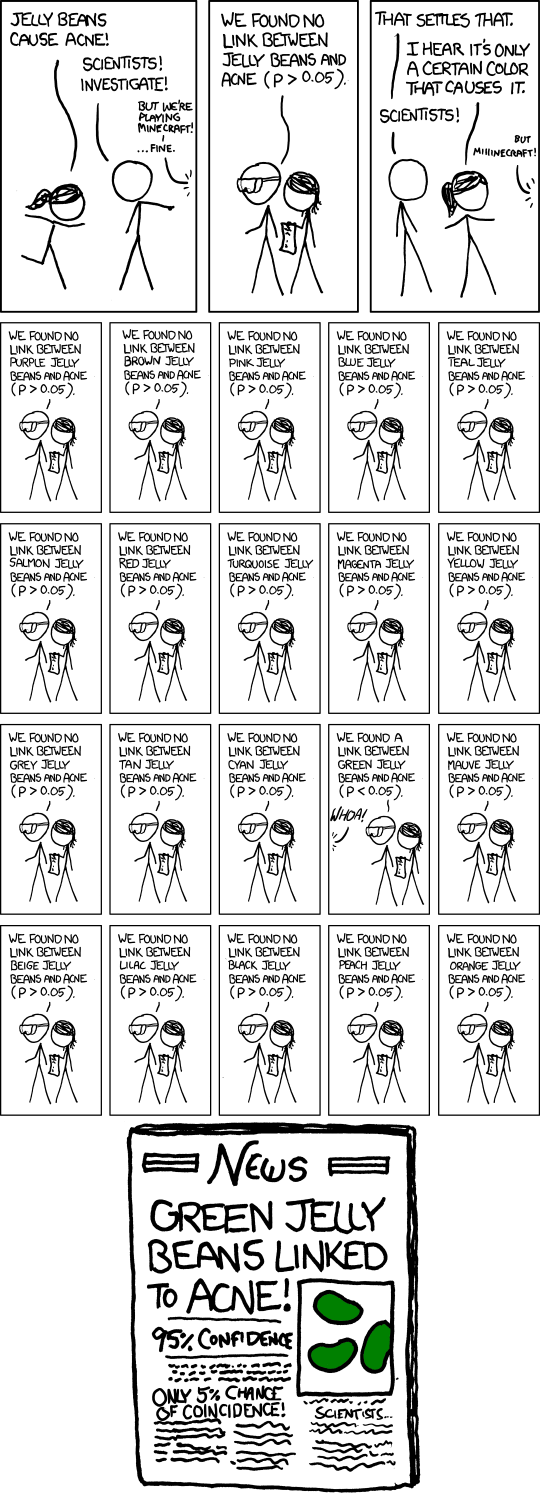
"'Don't confuse statistical and substantive significance!'" That comment-ready slogan would be just as much a conversation-stopper as correlation does not imply causation, yet people rarely say it. The spurious correlation stands apart from all the other foibles of statistics. It's the only one that's gone mainstream. Why?"
The answer is pretty obvious -- people abuse causation/correlation much more often, and more blatantly, than they "abuse" statistical significance.
More rumination and the conclusion from Engber:
"I wonder if it has to do with what the foible represents. When we mistake correlation for causation, we find a cause that isn't there. Once upon a time, perhaps, these sorts of errors—false positives—were not so bad at all. If you ate a berry and got sick, you'd have been wise to imbue your data with some meaning. (Better safe than sorry.) Same goes for a red-hot coal: one touch and you've got all the correlations that you need. When the world is strange and scary, when nature bullies and confounds us, it's far worse to miss a link than it is to make one up. A false negative yields the greatest risk.
"Now conditions are reversed. We're the bullies over nature and less afraid of poison berries. When we make a claim about causation, it's not so we can hide out from the world but so we can intervene in it. A false positive means approving drugs that have no effect, or imposing regulations that make no difference, or wasting money in schemes to limit unemployment. As science grows more powerful and government more technocratic, the stakes of correlation—of counterfeit relationships and bogus findings—grow ever larger. The false positive is now more onerous than it's ever been. And all we have to fight it is a catchphrase."
So he has meandered back to the basic point -- that there currently IS a lot of abuse of correlation/causation going on, in all manner of discourse. and that this IS a problem. If that's the case, why is he so against people trying to point it out?!
His final words -- "And all we have to fight it is a catchphrase" -- are baffling. If overuse of correlations is a problem, and our only weapon is this catchphrase, why is he preaching unilateral disarmament?! Why does he "correlate" use of this phrase with "Internet blowharded[ness]"?
It might be our only weapon against all these false correlations, but it's a pretty effective one -- it reminds people, in language that nearly everyone understands, that a correlation -- such as the fact that people who create jobs are typically rich -- says nothing about causation. The state of being rich does not cause one to create jobs, and giving more money to the rich (by lowering their taxes) will not cause the rich to create more jobs. What's odd is what I observed when I started this post -- that so few people on the internet had pointed out that the "job creator" myth is yet another example of the causation/correlation fallacy, even though that's so obviously what it is.
If you're one of those internet blowhards that likes to point out causation/correlation fallacies, keep up the good work!
If you're one of those internet blowhards that likes to point out causation/correlation fallacies, keep up the good work!
(And for the record, I'm still afraid of poison berries.)
Tuesday, October 2, 2012
Working Against the Public Interest -- Bain Capital and Tax Lawyers
There are some professions in which, no matter how you slice it, your work is ultimately not in the public interest. Burglary is one such profession. Another is where you own a towing company and hire people to spot cars that are illegally parked (even very temporarily and inadvertently), and then zoom out and tow the car before the owner gets back. Selling firearms to crazy people is another one. So is being a tax lawyer.
Ok, there are a lot of perfectly respectable people who are tax lawyers. I believe the husband of Supreme Court Justice Ginsburg was one (also a tax professor, helping churn out more tax lawyers). There's certainly nothing illegal about what they do -- they are simply zealously representing their clients and helping them to navigate an extremely complex tax system so as to ensure that the clients "don't pay a penny more" in taxes than they owe. You can even argue that this is in the public interest, because it's all consistent with laws passed by Congress, and in some cases it might help expose loopholes that need to be closed. And of course, if one tax lawyer doesn't do it, another will.
But in the short run, it's not in the public interest to create schemes that help extremely rich people (or corporations) save taxes. And given our history, I can't see any long-run benefit either -- tax lawyers have been saving billions of dollars for their clients for many years, and I honestly can't see how society has benefited from that in any way. If there were no tax lawyers (or accountants doing the same thing), rich people (and corporations) would pay more taxes, and the government would have more revenue.
Yet if I were rich, and my goal were to not to "pay a penny more in taxes than I owed," I probably would find a tax lawyer or an accountant who would help me do just that, as long as it was legal. And then perhaps some day I would run for President on the platform that we need to stop funding programs like Medicaid (i.e. medical care for poor children) since the government doesn't have enough money to pay for those programs. But why doesn't government have the money? See above -- a lot of rich people (and corporations) like me, complying with the letter, but not the spirit, of the tax laws.
Today's New York Times gives a lot of good detail on how Mitt Romney, through Bain, has avoided to pay tons of taxes. I didn't follow it completely, but it sounds like he and/or his wife still have a lot of money invested in Bain. So that makes Bain's tax practices relevant in assessing Romney's tax returns. And one example I think I understood was this:
-- In 2006, Bain and the Blackstone Group joined forces to buy Michael’s -- the arts and crafts stores -- for $6 billion in mostly-borrowed money.
Ok, there are a lot of perfectly respectable people who are tax lawyers. I believe the husband of Supreme Court Justice Ginsburg was one (also a tax professor, helping churn out more tax lawyers). There's certainly nothing illegal about what they do -- they are simply zealously representing their clients and helping them to navigate an extremely complex tax system so as to ensure that the clients "don't pay a penny more" in taxes than they owe. You can even argue that this is in the public interest, because it's all consistent with laws passed by Congress, and in some cases it might help expose loopholes that need to be closed. And of course, if one tax lawyer doesn't do it, another will.
But in the short run, it's not in the public interest to create schemes that help extremely rich people (or corporations) save taxes. And given our history, I can't see any long-run benefit either -- tax lawyers have been saving billions of dollars for their clients for many years, and I honestly can't see how society has benefited from that in any way. If there were no tax lawyers (or accountants doing the same thing), rich people (and corporations) would pay more taxes, and the government would have more revenue.
Yet if I were rich, and my goal were to not to "pay a penny more in taxes than I owed," I probably would find a tax lawyer or an accountant who would help me do just that, as long as it was legal. And then perhaps some day I would run for President on the platform that we need to stop funding programs like Medicaid (i.e. medical care for poor children) since the government doesn't have enough money to pay for those programs. But why doesn't government have the money? See above -- a lot of rich people (and corporations) like me, complying with the letter, but not the spirit, of the tax laws.
Today's New York Times gives a lot of good detail on how Mitt Romney, through Bain, has avoided to pay tons of taxes. I didn't follow it completely, but it sounds like he and/or his wife still have a lot of money invested in Bain. So that makes Bain's tax practices relevant in assessing Romney's tax returns. And one example I think I understood was this:
-- In 2006, Bain and the Blackstone Group joined forces to buy Michael’s -- the arts and crafts stores -- for $6 billion in mostly-borrowed money.
-- Michael's started having problems, and it became possible in early 2009 to buy Michael's debt for pennies on the dollar (I guess the assumption was that Michael's was going to go down). Bain and Blackstone (the owners of Michael's) went ahead and bought Michael's debt for exactly that -- pennies on the dollar.
-- Specifically, they paid $28.6 million for about $193.6 million in Michael’s
debt.
-- That's something every American consumer would love to be able to do. Say I have $100K in credit card debt. It looks like I'm going down. Wouldn't it be nice if I could simply "buy" that debt myself for $20K? Not something I get to do, but apparently the big boys get to do it routinely.
-- If they had simply bought it themselves, in the U.S., that would have been one thing -- the U.S. tax code is smart enough to say they would at least have to pay income tax on the money they make on a deal like that (buying their own debt). It would count as "cancellation of debt" income. But they aren't stupid, and they have good tax lawyers, so they created a shell company in Luxembourg -- Ursa -- to do the actual buying.
-- Ursa subsequently "sold" the debt for $200 million in late 2009 and early 2010. (Note that it took less than a year for Ursa to make a nearly seven-fold profit of $170 million. Nice work if you can get it.)
-- Although Bain (and Blackstone) owned Ursa, and Bain (and Blackstone) owned Michael's, that doesn't necessarily mean that Michael's and Ursa are "related" for purposes of the tax laws. Thus, since the money Ursa made by buying Michael's debt wasn't attributable to Michael's, Michael's didn't have to pay the "cancellation of debt" income it would otherwise have had to pay (had it bought and sold its own debt).
-- Not stated in the NYT article is the apparent fact that Michael's must have made an amazing recovery in 2009. In other words, from reading the article, we can infer that Michael's was in such deep trouble in early 2009 that one could buy so much of its debt for less than 15 cents on the dollar, but by the end of 2009, its debt was back to being worth its full value (since Ursa was apparently able to sell the debt for $200M).
-- Implicit in the article is also the fact that this "investment" opportunity was available to anyone, or at least anyone with $28.6 million on hand. Apparently Michael's creditors were willing to sell the debt at that discount, so another truly unrelated company could have made the same killing that Ursa made. The NYT isn't exactly begrudging Ursa its profits (at least not in the full amount); instead, it's trying to show how the transaction ultimately saved Michael's (and thus Bain, and thus Romney) money..
-- It's hard to say exactly how much money Michael's saved. But it's certainly clear that if Michael's had bought its own debt, it would have had to pay “cancellation of debt” income on its "profits" (at least according to NYT). I guess that tax would arise on the day it bought the debt for the $28.6 million, since at that point, about $160 million in debt would have disappeared.
-- The NYT article also says that "Federal
withholding on interest payments by Michael’s was another potential issue," although the article doesn't give me enough information to figure out just what this means. It tends to suggest that if Michael's debts were originally held by U.S. entities, the IRS would get some tax on the interest income of those entities. Obviously, a foreign entity wouldn't have that problem, so that's less tax to the U.S. tax system.
-- The NYT concludes that "[t]he exact amount saved through the Ursa maneuver is
difficult to calculate," but ultimately suggests that it might have been worth more than "$50 million to Michael’s bottom line."
-- How much of this went to Mitt? Here's what NYT says:
"Two Bain funds, in one of which Mrs. Romney’s trust held up to a $1 million dollar stake, invested about $13.5 million into Ursa, through a Caymans entity."
So without knowing the total size of the Bain fund that Mrs. Romney invested in, it's impossible to tell how much of "her" money actually could be allocated to the Ursa transaction. If we assume that the Bain company was set up specifically for this purpose -- i.e.that the full $13.5 million was all that it had -- then we could say that the Romneys had got 7.4% of Bain's profits on the transaction. If the Bain fund was bigger than just this one transaction, then the Romneys got less . . . .
UPDATE Nov. 3, 2012 -- PriceFixer's closing argument on the election is here.
UPDATE Nov. 3, 2012 -- PriceFixer's closing argument on the election is here.
Subscribe to:
Posts (Atom)